Installation view of ‘The Human Condition(Closer to Bliss)’, in RMIT Honours Grad Show, Royal Melbourne Institute of Technology, Melbourne, Australia, 2015

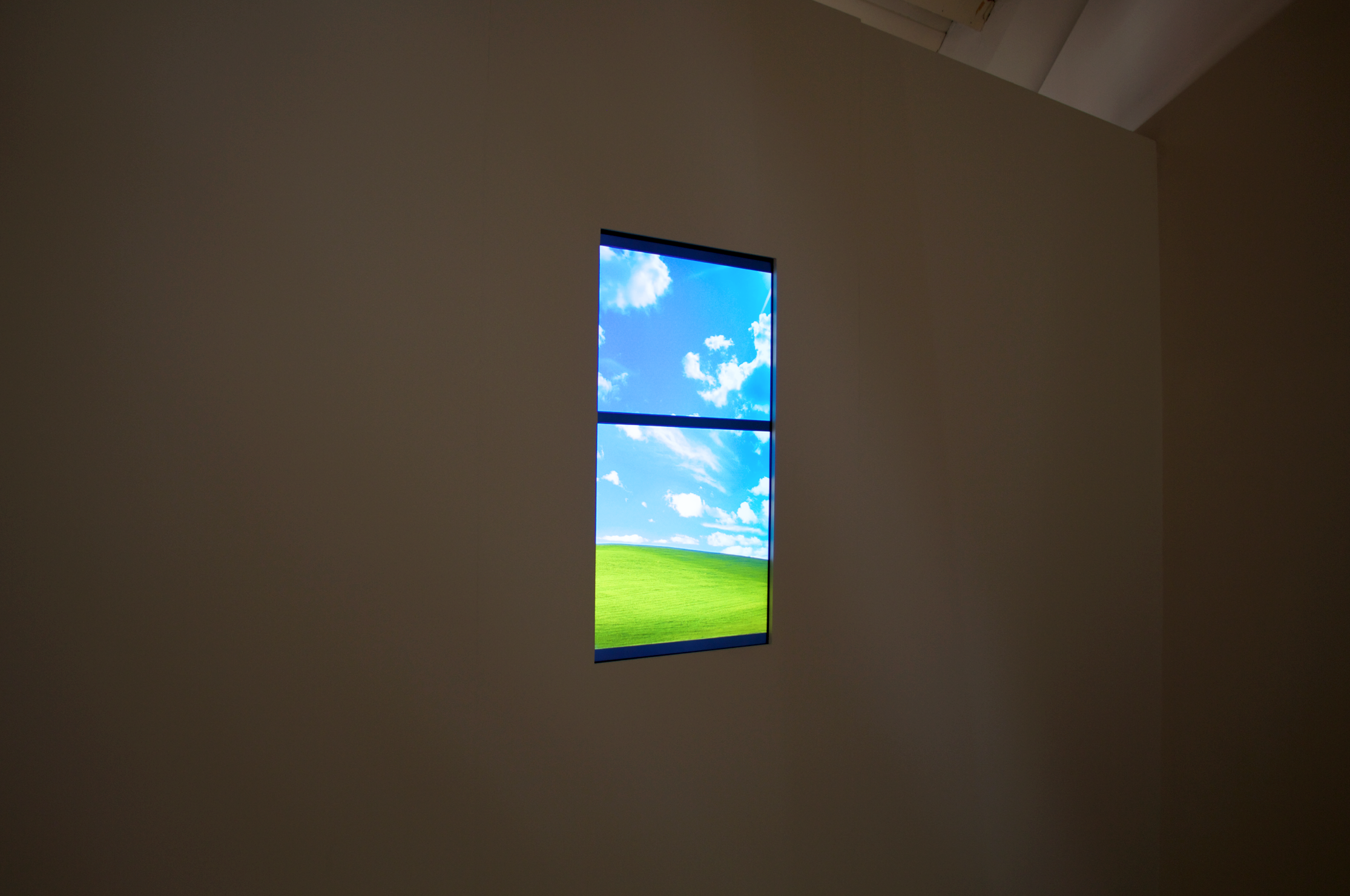
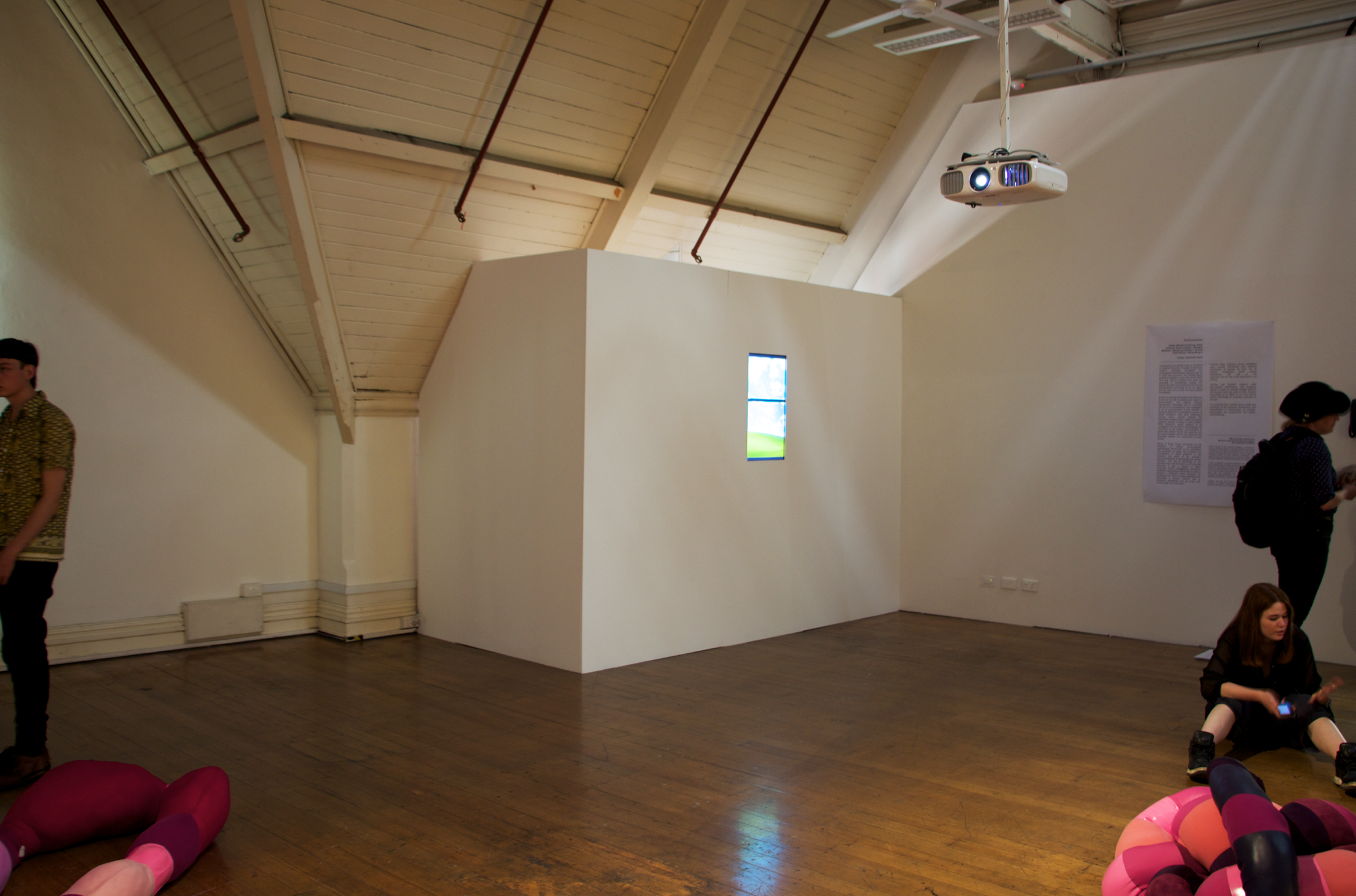
The Human Condition (Closer to Bliss), 2015
Timber, MDF, digital screen
Dimensions variable
The core concept of the ‘Confusion of Confusions’ series was realised and developed into a final installation titled as The Human Condition (Closer to Bliss). It consisted of a vertically positioned screen inserted in a white wall. The content of the screen was divided into two parts: the upper part was a video showing cloud moving in blue sky while the bottom part was a static image of bright blue sky with green hill. The upper moving image was a YouTube footage titled Closer to You (2010) by Brett Sanders. The bottom image Bliss (1996) was taken by American photographer Charles O’Rear. The ‘screen window’ was placed in front of a real window originally built in the room but was blocked by a temporarily built wall.
The Human Condition (Closer to Bliss) explores how digital screens have immerged into and influenced our lives and a metaphor of how we perceive the world through screen nowadays. It is also a rethinking process of my initial approach to the computer world, in which the desktop picture was occupied by the operation systems Windows XP produced in 2001. Rene Magritte’s approach to reality was referenced in relation to Immanuel Kant’s philosophical concept of the nouminal and phenomenal worlds.
‘I placed in front of a window, seen from inside a room, a painting representing exactly that part of the landscape which was hidden from view by the painting. Therefore, the tree represented in the painting hid from view the tree situated behind it, outside the room. It existed for the spectator, as it were, simultaneously in his mind, as both inside the room in the painting, and outside in the real landscape. Which is how we see the world: we see it as being outside ourselves even though it is only a mental representation of it that we experience inside ourselves. In the same way, we sometimes situate in the past a thing which is happening in the present. Time and space thus lose that unrefined meaning which is the only one everyday experience takes into account.’ – Rene Magritte (cited in Magritte, 1970 by Suzi Gablik)
In light of Kant’s concept, the outside world depicted in the painting would be the nouminal world while the painting inside the house is the phenomenal world. Thus, the house is a metaphor of a person’s brain and the window would be the person’s eye. In The Shock of the New (1980), Robert Hughes has examined and remarked on this painting that ‘this play of image and reality suggests that the real world is the construction of mind.’ This suggestion echoes with Lehar’s concept of the world we perceive.
 Weng Io Wong