Other version:
.
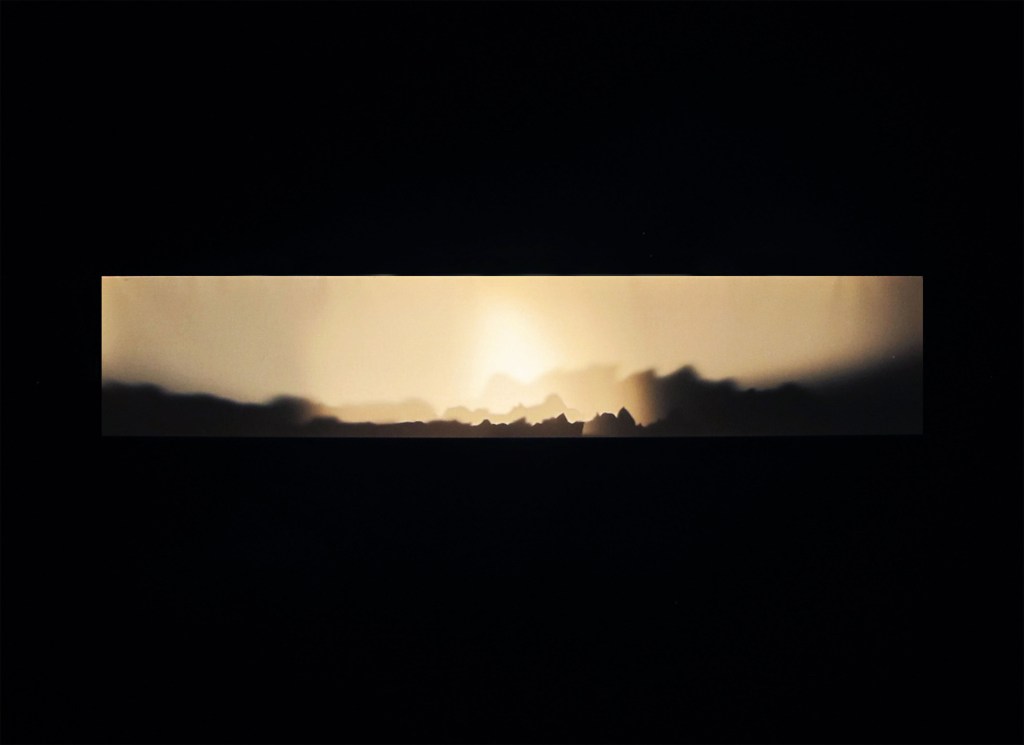
This kinetic installation is about time and space, and is based on my perception of living in Melbourne for several years. As a Chinese student, I experience a confluence of varied feelings such as cultural difference, homesickness and uncertainty. The urge to refer to my own culture as a touchstone underpins the creation of this work, which is based on the Chinese landscape painting (Shan-Shui-Hua).
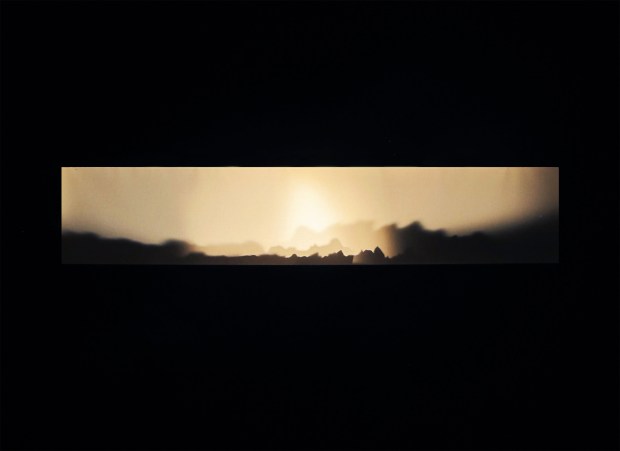
The installation is divided into two parts by a wall: a part that presents the finished ‘painting’ and the other part that shows the mechanism of how things work at behind. A turntable holding several plaster models of a Chinese character representing ‘mountain’ (山) will revolve in front of a screen which is built in a wall. Three Dedo lights in front of the turntable will cast a silhouette of the characters onto the screen, evoking the transition of time and the unfurling of a traditional Chinese scroll. The visual effect is reminiscent of Chinese landscape ink painting and Chinese calligraphy.
The concept of this installation is based on the famous Chinese saying about the perception of the mountain Lu Shan:
‘When you look at Lu Shan from the side, it will look like a ridge; when you look at it from an inclined angle, it will look like a peak. It looks different when you look at it from a distance, when you view it more closely and at a high or a low altitude. The reason why you can’t tell the true shape of Lu Shan is because you are inside the mountain.’
This saying is about the perception of being an insider and outsider of a particular event. When you are an insider of an event, you might not be able to see the whole situation clearly. However, when you step out of the situation, you can see things clearer than before. A ‘traditional’ Chinese painting is created by the illusion formed by the shadow of the characters. And the role of the wall is to form a transitional bridge or experience from being an insider to an outsider.
Unlike Western painters, Chinese landscape painters use a ‘Multi-point perspective’ rather than a ‘Single Point perspective’. The multi-point perspective refers to both of the Chinese Brush Painting technique and the Chinese belief in the philosophy that the Heaven, Earth and Man are all One. The way that people appreciate the Chinese scroll is to look at it section by section and appreciate it progressively. Using a turntable to present the ‘painting’ mimics the traditional way people view the scroll. For me, the concept of circulation is a very important element in this work because everything is a circulation or a cycle and the turntable represents this element physically.
The number three is significant in this work: the idea of three perfections and three distances. The famous painter Kuo Hsi wrote in his book Sublime notes by forests and rivers:
‘Mountain has three distances. Looking at the top of a mountain from its base shows distance stressing its height. Looking at the back of a mountain from its front shows distance stressing its depth. Looking at the mountain beyond from a mountain close by shows distance stressing its leveled broadness.’
Three perfections in a traditional Chinese scroll refer to the incorporation of poetry, calligraphy and painting. In this installation, three lights are used to create three layers of shadow to show its height, depth and broadness. Although the installation can be seen as two parts and they are like the combination of the two perfections which are painting and writing, the work will only be activated as a whole when the viewer is present, which adds on the two perfections and becomes three perfections.
Reference:
http://www.art-virtue.com/painting/techniques/perspective.htm
 Weng Io Wong